E-Invoicing
ZATCA E-Invoicing for Small Businesses: What You Need and What It Costs
Every VAT-registered business in Saudi Arabia must issue e-invoices, whatever its size. What small businesses need to get compliant, and how to start for free.
By Bytize Team1 min read
A common assumption among small businesses in Saudi Arabia is that e-invoicing is only for large companies. It isn't. If you are VAT-registered, you must issue e-invoices, whether you run a single restaurant or a small retail shop.
Who has to comply
- All VAT-registered businesses in KSA must comply
- There is no minimum revenue threshold for Phase 1 (Generation)
- Phase 2 (Integration) is rolling out in revenue-based waves
What a compliant invoice needs
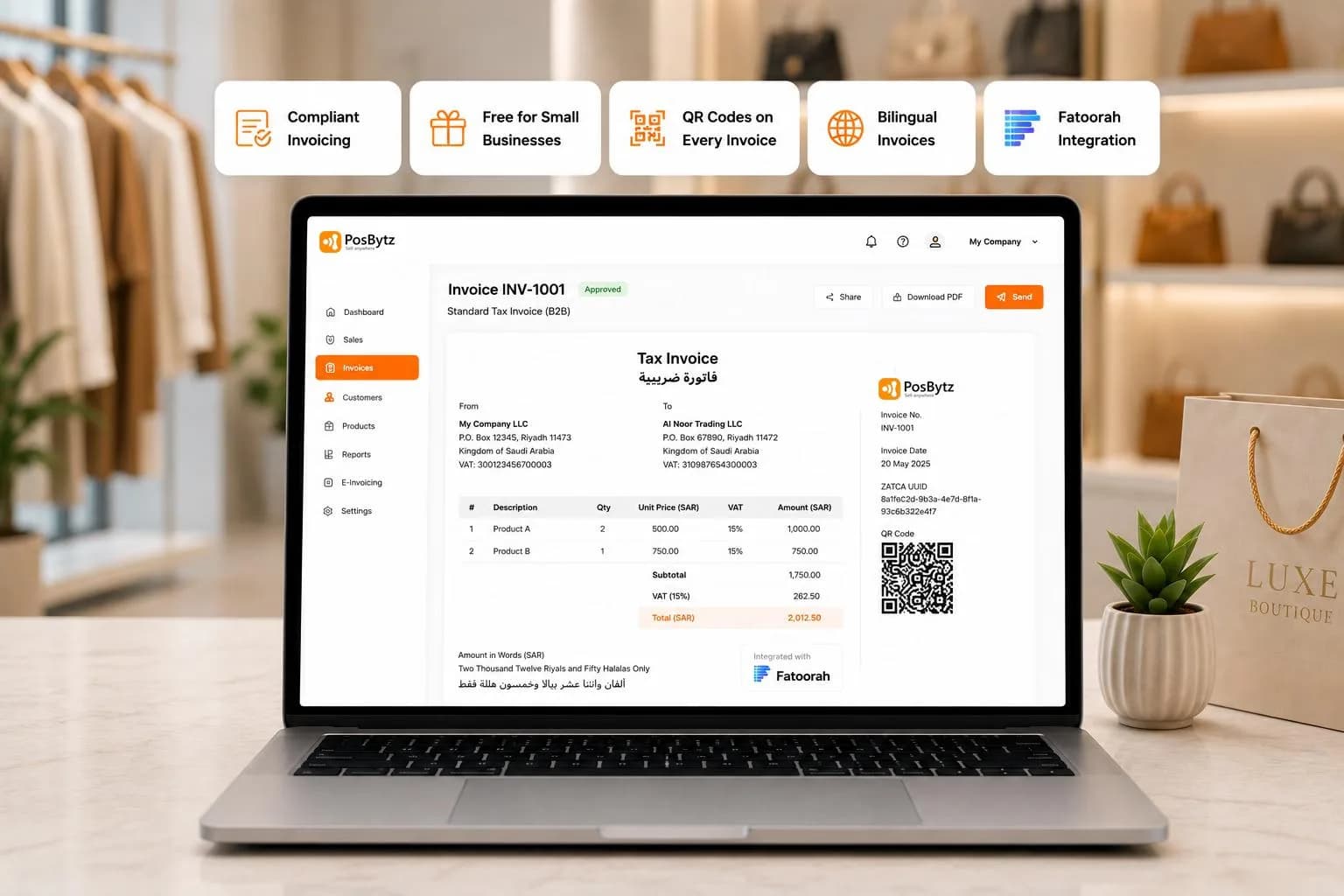
ZATCA requires a QR code on every invoice, both standard (B2B) and simplified (B2C). Invoices are bilingual, in Arabic and English, and carry a UUID and all the mandatory fields. Good software generates all of this automatically and validates each invoice against ZATCA rules before it is issued, flagging any missing fields.
What you need to get started
- Your VAT registration number (TIN) and business details
- Your product list, imported by CSV or added manually
- A device you already own: Windows, Android, iPad or any browser
No hardware purchase, IT team or developer is required.
What it costs
PosBytz has a free tier for small businesses. It covers ZATCA Phase 1 compliant invoice generation, QR codes and UUIDs, bilingual invoices and basic POS billing, with no credit card required. When you need Phase 2 Fatoorah integration, multi-outlet management, accounting, inventory or CRM, you upgrade, and your invoices, products and customer data carry over with no migration.
Start with free ZATCA e-invoicing, or read about Phase 1 vs Phase 2.